
Currently Empty: £0.00
0 Comments
Last Updated: November 2, 2026
Quick Summary
To assess solid wood furniture quality at home, check the grain, edges and underside for natural timber, tap the surface for a warm solid sound, and feel for weight. Then inspect the drawer and frame joints, since dovetails and mortise and tenon joints signal sound construction.
- Natural grain that varies across the surface suggests real timber, while repeating patterns suggest printed or veneered surfaces.
- Solid wood edges show the same grain as the top, while veneer edges reveal a thin layer over a different core.
- Solid hardwood produces a deeper, warmer sound when tapped and feels heavy for its size.
- Dovetail and mortise and tenon joints resist racking and twisting better than stapled or pocket-screwed joints.
- Ask the seller whether the piece is solid wood throughout, which species it uses, and how the drawers are joined.
Table of Contents
- Why Checking Solid Wood Quality Matters Before You Buy
- How to Tell If Furniture Is Solid Wood
- Furniture Joinery Types and What Makes Them Strong
- Solid Wood Furniture Quality Checklist
- Hardwood, Softwood and Finish: What the Labels Really Mean
- Questions to Ask When Buying Solid Wood Furniture
- Booking a Look at Pieces in Person Before You Commit
- Frequently Asked Questions
Why Checking Solid Wood Quality Matters Before You Buy
Solid wood furniture is built to last for decades, but only if it is genuinely solid wood. Many shoppers assume a piece is solid oak or pine when it is actually veneer over a cheaper core. Knowing how to assess solid wood furniture quality at home helps you spot the difference before you hand over your money.
Solid wood furniture is made from whole pieces of timber, not thin layers glued together. Veneer is a thin slice of real wood bonded to a cheaper board. Both can look similar in a shop, but they age very differently.
A few simple checks can save you from disappointment:
- Solid wood resists dents and warping better over time
- Veneer can peel or bubble when humidity changes
- Solid wood can be sanded and refinished many times
- Veneer usually cannot be sanded back without showing the core beneath
Watch out: Do not judge quality from a photo alone. Lighting and staging can make laminate look like timber, so always inspect the piece in person where you can.
How to Tell If Furniture Is Solid Wood
Start with a close look at the surface and the edges. Solid wood shows natural variation from one board to the next, while printed laminate repeats the same pattern. Run your hand slowly across the top and the sides. Real timber feels warm and slightly textured, while laminate feels smooth and plasticky.
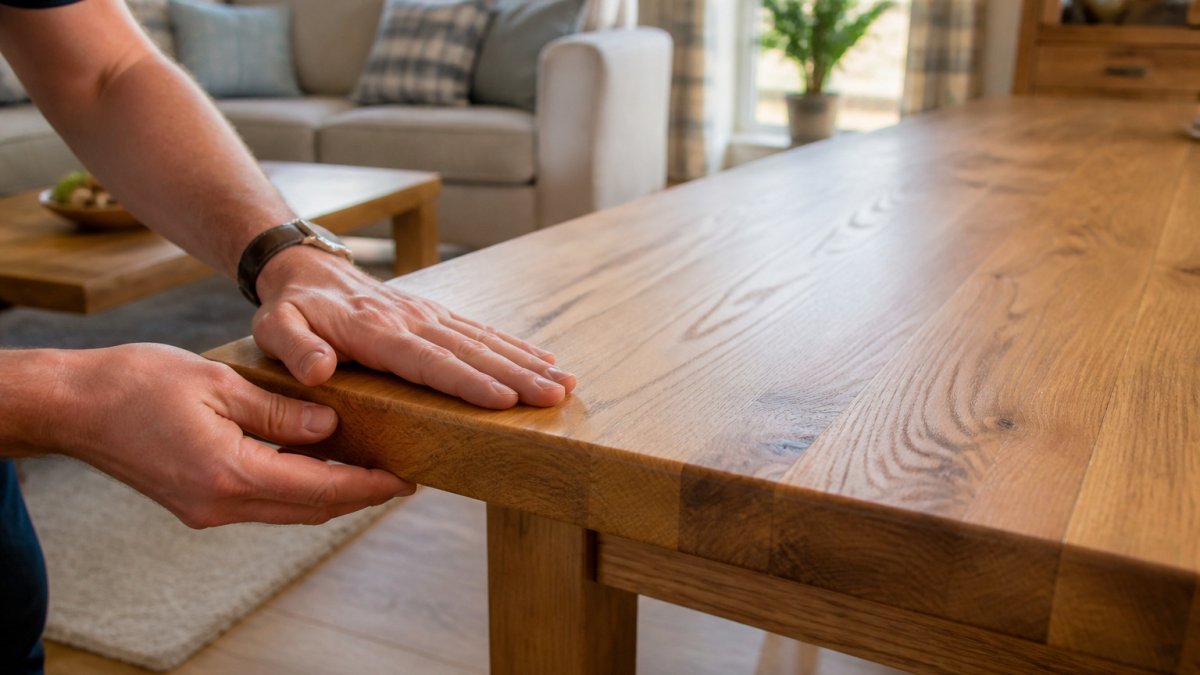
!Close-up of hands running a palm along the edge of a wooden table in a bright living room, with visible natural grain running across the top
Examining Wood Grain Patterns
Wood grain is the clearest sign of real timber. Look for lines that flow naturally and change slightly across the piece. Grain on a solid board runs continuously, with small knots, colour shifts and irregular rings.
Repeating patterns are a warning sign. If the grain looks identical across several panels, it is probably a printed or veneered surface. Many manufacturers also use the word “wood” loosely, so trust what you see more than the label.
Inspecting Edges and Undersides for Veneer or Particleboard
The edges and underside reveal what the piece is really made from. Check the exposed edge of a tabletop or the side of a drawer front.
- Solid wood edges show the same grain as the surface
- Veneer edges often show a thin layer with a different colour underneath
- Particleboard and MDF look grey, granular or uniform in colour
- Splintered or chipped edges can point to a cheaper core
Turn the piece over where you can. Solid timber usually has a neat, unfinished underside. Chipboard undersides often look rough and cheaply sealed.
The Tap Test and Weight Check
Tap the surface gently with your knuckles. Solid wood produces a deeper, warmer sound. Thin veneer and hollow panels sound higher and more hollow.
Weight also matters. Solid hardwood is heavy for its size. If a large cabinet feels surprisingly light, it may use particleboard or thin panels inside.
Furniture Joinery Types and What Makes Them Strong
Joints are where furniture either lasts or fails. A solid oak top is wasted if the frame is held together with staples and glue, because the joint, not the timber, takes the load every time a chair is sat on or a drawer is pulled. Understanding joinery lets you judge build quality in seconds, and it is the single check most shoppers skip.
What each joint actually does
- Dovetail joints: interlocking wedge-shaped pins and tails cut across the grain. The angle means the joint resists being pulled apart in one direction and resists racking in the other, which is why it is the traditional choice for drawer boxes. Look for tails that are evenly spaced and flush with the drawer side; gaps, filler or a mix of machine-cut tails with hand-cut pins suggest a budget build.
- Mortise and tenon: a projecting tenon on one piece fits into a cut mortise on another, usually pinned or glued. It is the standard joint for chair frames, table aprons and bed rails because it resists twisting and bending loads. A well-cut tenon fills its mortise with no visible gap and is often reinforced with a dowel through the cheek.
- Dowel joints: wooden or metal pins drilled into both faces. They are acceptable in mass-market pieces when the holes are precise and the dowels are glued, but they rely on glue strength rather than interlocking geometry, so they are weaker under repeated racking.
- Biscuit and domino joints: oval or loose-tenon inserts used in panel glue-ups and frames. They align boards well but add little resistance to pulling apart, so treat them as a sign of efficient factory construction rather than premium joinery.
- Pocket screws and staples: angled screws or staples driven into a joint. Fast to assemble and common in flat-pack, but they concentrate stress at the screw head and loosen with humidity cycling. Visible staples at a corner with no interlocking wood are a clear signal of price-led construction.
How to inspect joints in the showroom
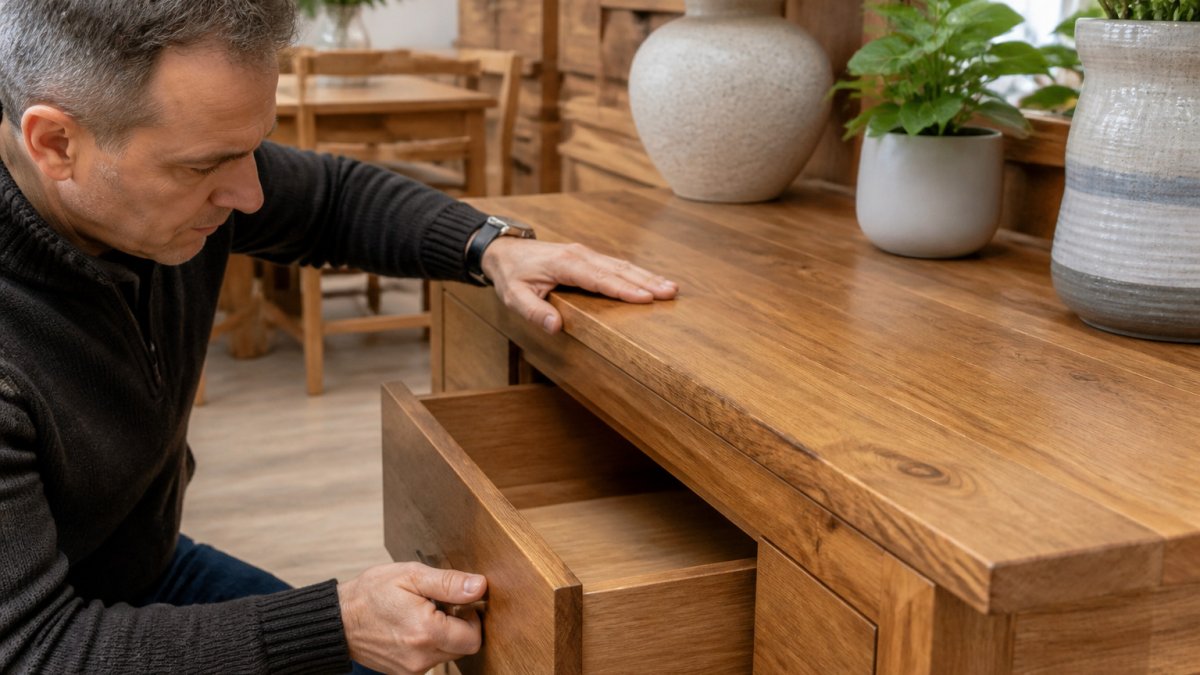
Open every drawer and look at the back corners: dovetails should be visible as interlocking wood, not a stapled butt joint. Turn a chair upside down and check the leg-to-seat joint for movement, a joint that flexes under hand pressure will loosen in use. Look at table aprons for a visible tenon or a pinned joint rather than a screw driven straight into end grain, which splits over time. Run a finger along the inside of a drawer side; a smooth, continuous dovetail line indicates care, while filler and uneven spacing indicate speed.
Watch out: A joint that looks tight in a warm, dry showroom can open in a centrally heated home, so ask whether the frame is glued and pinned as well as jointed, and check for movement before you buy.
Species and joinery together
Joinery choice should match the timber. Dense hardwoods such as oak, ash and walnut hold cut joints well because the fibres resist crushing, while softer species like pine dent more easily at joint shoulders and are often dowelled or screwed instead. A piece described as solid oak with stapled corners is a contradiction worth questioning.
The joint types below are the ones the article uses to judge build quality, with what each one does and what to look for.
| Joint | Strength | What to look for |
|---|---|---|
| Dovetail | Resists pulling apart and racking | Evenly spaced, flush tails with no gaps or filler |
| Mortise and tenon | Resists twisting and bending | Tight fit with no visible gap, often pinned |
| Dowel | Relies on glue strength | Precise holes and glued dowels |
| Biscuit or domino | Aligns boards, adds little pull strength | Factory efficiency, not premium joinery |
| Pocket screw or staple | Loosens with humidity cycling | Visible staples at corners signal price-led build |
Solid Wood Furniture Quality Checklist
Use this checklist in the shop or at home:
- Grain looks natural and varies across the surface
- Edges show solid timber, not a thin veneer layer
- Underside is neat and unfinished, not rough chipboard
- Drawers use dovetail or mortise and tenon joints
- Knocking produces a solid, warm sound
- The piece feels heavy for its size
- Hardware is screwed or bolted securely, not stapled
- Drawers and doors run smoothly without wobble
A piece that passes most of these checks is far more likely to be genuine solid wood with sound construction.
Hardwood, Softwood and Finish: What the Labels Really Mean
Labels can be confusing. Hardwoods such as oak, ash and walnut come from broad-leaved trees and are generally denser and more durable (Timber and the uses of wood). Softwoods such as pine come from conifers and are lighter and easier to dent, though they can still make good furniture.
The finish is the coating on top, such as lacquer, oil or wax. A good finish protects the wood, but it can also hide the true grain and colour. Ask whether the timber is hardwood or softwood, and whether the finish is applied over solid timber or veneer. A clear answer shows that the seller knows their stock.
Questions to Ask When Buying Solid Wood Furniture
Before you buy, ask the seller these questions:
- Is this piece solid wood throughout, or only on the surface?
- Which species of wood was used, and is it hardwood or softwood?
- How are the drawers and frame joined?
- What is the finish, and how should I care for it?
- What warranty or return terms apply?
A reputable retailer will answer these clearly. Vague answers are a reason to pause and look elsewhere.
Booking a Look at Pieces in Person Before You Commit
Seeing furniture in person is the best way to test these checks. You are welcome to visit our Finedon showroom to see furniture in person. You can also browse our sofas and chairs online to see specifications before you visit.
For a solid wood bed, you can read the build details on our hand-made bedframe range. If you have questions about materials, construction or warranty, contact our team before you commit.
Frequently Asked Questions
How can you tell if furniture is made from solid wood?
Look at the edges and underside first. Solid wood shows continuous grain that runs through the full thickness of the piece, while veneer over particleboard or MDF shows a thin layer of decorative surface with a plain, uniform core visible at the edges. Check drawer fronts and table tops for matching grain across joins, and look inside cabinets or under seats for raw wood rather than laminate or paper-faced board. Weight is also a useful clue, as solid wood is generally heavier than engineered boards of the same size.
How do you check the quality of solid wood furniture?
Check the joints, finish and hardware together. Good joints such as dovetails or mortise and tenon should fit tightly with no gaps, and screws or staples should not be exposed or loose. Run your hand over the surface to find splintered edges, uneven stain or drips in the finish. Gently rock the piece to see whether it wobbles, which can signal weak construction. Pull out drawers and open doors to test smoothness of movement.
What questions should you ask before buying solid wood furniture?
Ask whether the piece is made from solid timber or veneer, which species of wood it uses, and how the joints are constructed. Ask about the finish and whether it is suitable for your room’s light and humidity. Also ask what the return policy is, whether delivery and assembly are included, and how the retailer handles damaged goods. Pricing depends on the piece, quantity and delivery, so check current prices and availability directly with HSH-furniture-northants on its website or by contacting the team for a quote.
Is solid wood furniture always better quality?
Not always. Solid wood offers durability and the ability to be sanded and refinished, but quality depends on the wood species, how it is dried, the joinery and the finish. A well-made engineered board piece can outlast a poorly built solid wood one. Judge each item on its construction rather than the label alone.