
Currently Empty: £0.00
0 Comments
Last Updated: October 26, 2026
Quick Summary
To check sofa quality, inspect the frame for solid hardwood and reinforced joints, test the springs by pressing different areas of the seat for consistent firmness, evaluate cushion density and shape retention, and examine fabric seams and weave tightness. Ask the retailer about frame material, spring type, foam density rating, and warranty coverage to make an informed choice.
- Quality sofas use foam rated at 40 kg/m³ or higher for seat cushions, while budget sofas often use foam below 30 kg/m³ that breaks down within years.
- Pocket springs and eight-way hand-tied springs provide better support and durability than sinuous springs or foam-only construction.
- Solid hardwood frames resist warping and cracking, while plywood and particleboard delaminate over time and fail quickly.
- Mortise-and-tenon joints or dowel construction create strong connections, while frames held together with only glue will eventually fail.
- Red flags include creaking sounds, wobbling movement, sagging that doesn’t recover, loose fabric, and visible staples instead of proper fastening.
Table of Contents
- Why Sofa Quality Matters When You’re Investing in Your Home
- Inspecting the Frame: The Foundation of Sofa Quality
- Understanding Springs and Support Systems
- Best Sofa Cushion Filling and Shape Retention
- Sofa Quality Checklist for In-Person Inspection
- Questions to Ask Before Buying a Sofa
- How to Check Sofa Quality When Buying Online
- Get Expert Advice on Your Next Sofa Purchase
- Frequently Asked Questions
Why Sofa Quality Matters When You’re Investing in Your Home
When you invest in a sofa, you’re not just buying a place to sit. You’re making a decision that will affect your home for years. The difference comes down to what you know before you buy.
Most people focus on style and price. They miss the structural details that determine whether a sofa will hold up. Frame quality, spring systems, cushion fill, and fabric durability are what separate a sofa that ages gracefully from one that sags and breaks down. At HSH-furniture-northants, we’ve spent over 35 years serving the Northamptonshire community.
Learning how to check sofa quality before buying can help you make an informed choice. Whether you’re shopping in person or online, the same principles apply: inspect the frame, test the support, evaluate the materials, and ask the right questions.
Inspecting the Frame: The Foundation of Sofa Quality
The frame is the skeleton of your sofa. Everything else, springs, cushions, fabric, depends on it. A solid frame means your sofa will sit level, resist wobbling, and support weight properly for years. A weak frame will twist, creak, and eventually fail.
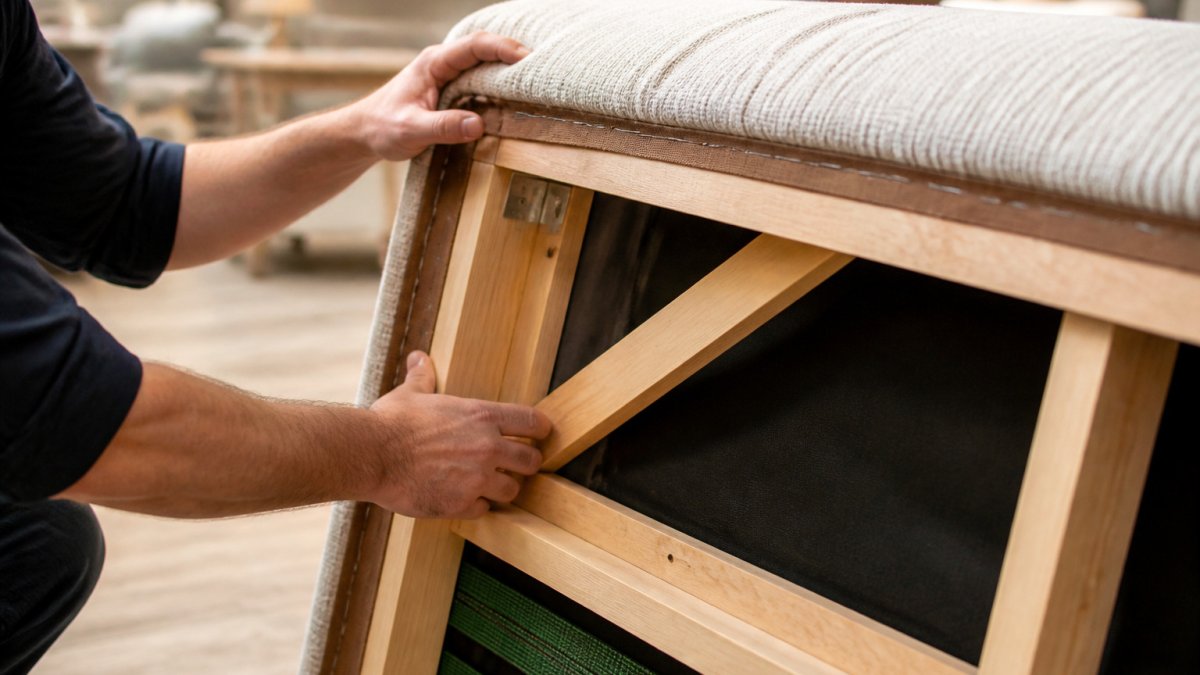
Solid hardwood versus engineered alternatives
Hardwood frames are the gold standard. Kiln-dried hardwood resists warping and cracking. It’s dense enough to hold joints tight without splitting. Engineered wood or plywood frames cost less, but they don’t perform the same way. Plywood can delaminate over time, especially in humid conditions (bsigroup.com). Particleboard is even weaker, it compresses under weight and fails quickly.
When you inspect a sofa, ask what the frame is made from. If the retailer can’t tell you, that’s a red flag. Solid hardwood should be specified clearly. If a sofa is described only as “wood frame” without detail, it’s likely engineered or mixed materials.
Joints and bracing techniques
How the frame is joined matters as much as the wood itself. Corner joints are the stress points. They need to be reinforced properly. Look for mortise-and-tenon joints or dowel construction, these create strong, lasting connections. Nails or staples alone are not sufficient for a quality sofa.
Bracing runs underneath and between frame sections. It prevents twisting and keeps the structure square. Run your hand along the underside of the frame. You should feel substantial diagonal or cross bracing. If the underside feels hollow or sparse, the frame lacks proper support.
Watch out: frames held together with only glue will eventually fail. Joints need mechanical reinforcement, dowels, mortises, or corner blocks, to survive years of sitting and shifting.
Understanding Springs and Support Systems
Springs are what make a sofa feel comfortable and keep it supportive over time. Different spring systems perform differently.
Pocket springs are individual coils wrapped in fabric. Each spring moves independently, responding to weight and pressure. Each spring moves independently, responding to weight and pressure. This design distributes support evenly and resists sagging.
Sinuous springs (also called no-sag springs) are continuous metal wires shaped in waves. They cost less than pocket springs but still provide decent support. Foam-only construction has no springs at all. It’s cheaper upfront but compresses quickly and offers minimal support after a few years.
When checking sofa quality, press down on the seat. It should feel firm but not rock-hard. Push from different spots, the centre, the edges, the corners. A quality sofa responds evenly. If one area feels softer or sags noticeably, the spring system is failing or unevenly constructed.
Best Sofa Cushion Filling and Shape Retention
Cushion fill determines comfort and longevity. High-density foam holds its shape longer than low-density foam. Down fill feels luxurious but compresses quickly and requires constant fluffing. A blend of down and feathers with a foam core offers a balance of comfort and durability.
The density of foam is measured in kilograms per cubic metre. Higher density means firmer support and longer lifespan. Quality sofas use foam rated at 40 kg/m³ or higher for seat cushions.
Shape retention matters. Cushions should return to their original shape after you sit on them. If they stay compressed or develop permanent body imprints, the fill is low-quality. Removable cushion covers allow you to replace filling if it deteriorates, extending the sofa’s life.
When testing a sofa, sit on it and stand up. Watch how quickly the cushion rebounds. Press your hand into the cushion firmly and hold for a few seconds, then release. A quality cushion bounces back. A poor one stays indented.
Sofa Quality Checklist for In-Person Inspection
Use this checklist to evaluate sofa quality systematically.
What to test and measure at the showroom
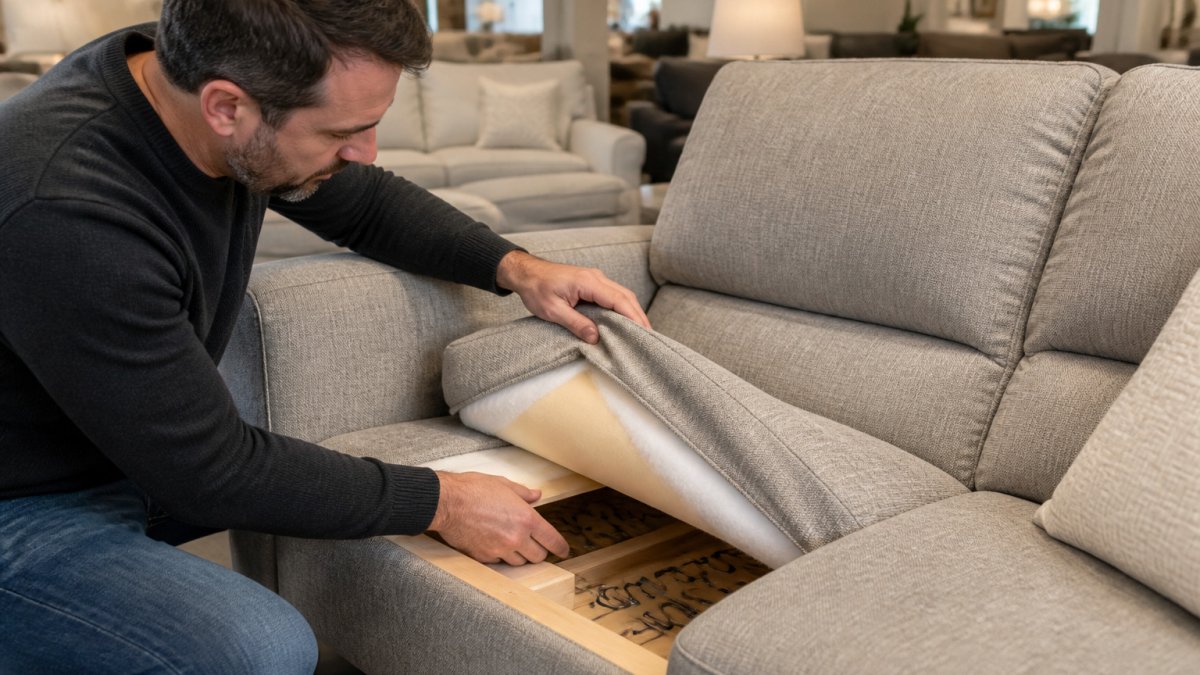
Start with the frame. Flip the sofa or look underneath. Check that the wood is solid and joints are reinforced. Feel for bracing. Look for gaps or cracks in the frame.
Test the springs by pressing down on different areas of the seat. The response should be consistent across the entire sofa. Sit on it fully and shift your weight. A well-made sofa doesn’t creak or wobble.
Examine the fabric or leather. Run your hand across it. Check for loose threads, uneven weaving, or thin spots. Look at the seams, they should be straight and tight, not puckered or loose.
| Quality Check | What to Look For | Red Flag |
|---|---|---|
| Frame | Solid hardwood, reinforced joints, visible bracing | Hollow sound, loose movement, gaps |
| Springs | Consistent firmness across seat, quick rebound | Soft spots, uneven support, creaking |
| Cushions | Dense feel, shape retention, no body imprints | Thin or compressing fill, permanent indents |
| Fabric | Tight weave, straight seams, no loose threads | Loose weaving, puckered seams, thin spots |
| Legs/Base | Stable, no wobble, proper attachment | Wobbly, loose, or missing reinforcement |
Check the legs or base. They should be sturdy and firmly attached. Rock the sofa gently side to side. It should not shift or creak. Legs should be wood or metal, not plastic or thin materials.
Red flags that signal poor construction
Creaking sounds when you sit down indicate loose joints or weak bracing. A quality sofa should be silent. Wobbling or movement in the frame means joints aren’t secure or bracing is insufficient. Sagging in the seat that doesn’t recover suggests weak springs or low-quality foam. Loose fabric or seams that pull apart easily point to poor stitching or cheap material.
Visible staples on the underside instead of tacks or proper fastening suggest shortcuts in construction. Uneven cushion heights or firmness across the sofa indicate inconsistent filling or poor quality control. Strong chemical smells (beyond normal new furniture odour) can signal low-quality materials or poor manufacturing standards.
Watch out: if a sofa feels unstable or makes noise when you sit on it, those problems won’t improve with time. They’ll get worse. Don’t assume you can “break in” a sofa with structural issues.
Questions to Ask Before Buying a Sofa
Asking the right questions reveals what a retailer knows about their products and how seriously they take quality.
Ask what the frame is made from and whether it’s kiln-dried. Ask about the spring system, pocket springs, eight-way hand-tied, sinuous, or foam-only. Ask the density rating of the foam in the cushions. Ask how the frame is jointed and whether it’s braced underneath.
Ask about fabric or leather composition. Is it a natural fibre or synthetic? How is it treated for stain resistance? Ask whether cushion covers are removable and replaceable.
Ask about delivery and setup. Will the retailer inspect the sofa for damage before delivery? What’s their process if it arrives damaged? Can they deliver to a specific room and position it properly? These details matter for protecting your investment.
How to Check Sofa Quality When Buying Online
Buying online removes the chance to sit on a sofa or inspect it in person. You have to rely on descriptions, images, and the retailer’s reputation. This makes research and the right questions even more critical.
Evaluating product descriptions and specifications
Read the full product description carefully. Quality retailers specify frame material, spring type, foam density, and fabric composition. If these details are missing, email and ask.
Look at product images from multiple angles. High-quality listings show the underside of the frame, close-ups of seams and fabric, and details of the spring system. Images taken in bright, natural light let you see construction clearly. Poor lighting or limited angles are common in budget listings.
Check whether the retailer provides dimensions and weight. A sofa’s weight tells you something about its construction. A very light sofa for its size probably has thin materials and weak bracing. Compare the weight to similar models from other retailers, significant differences suggest different construction quality.
Assessing delivery and return policies
Before buying, review the return policy carefully. Understand the return policy for sofas purchased online(page:3) so you know your options if the sofa doesn’t meet expectations when it arrives.
Ask how the sofa is packaged and whether it’s inspected before dispatch. Ask whether the retailer will inspect for damage upon delivery and what process exists if damage is found. Will they replace it or refund you?
Understand the timeline. How long do you have to inspect and report damage? Can you return the sofa if it doesn’t fit your space or you’re unhappy with quality? Some retailers offer trial periods. Others don’t. A generous return window gives you confidence that the retailer stands behind their products.
Ask about assembly. Does the price include delivery and setup, or are those extra? Will the retailer position the sofa in your chosen room and remove packaging? These services matter when a sofa is large and heavy.
Get Expert Advice on Your Next Sofa Purchase
Choosing a quality sofa means understanding what to look for and asking the right questions. Frame strength, spring systems, cushion fill, and fabric durability are what determine how long a sofa will last and how well it will perform. Whether you’re shopping in person or online, these principles guide you toward a sofa that will serve your home well.
With over 35 years of experience serving the local community, we understand what quality means and why it matters.
Frequently Asked Questions
How can you tell if a sofa is good quality?
When assessing a sofa, check the frame, support, and cushion filling. Look at the joints, seams, and fabric, and check under the base for loose threads or gaps.
What should I check on a sofa before buying it?
Inspect the frame and check for flex or creaking. Examine the cushions, stitching, fabric, and legs. Ask about the filling materials and spring system, and sit on the sofa to assess its comfort and support.
What is the best filling for sofa cushions?
Cushion fillings vary. Check product specifications or ask the retailer about the filling’s density and composition.
How can I judge sofa quality when buying online?
Request product specifications, including frame material, spring type, and cushion density. Review the available photos and customer reviews, and check the return policy. Contact the retailer with questions about construction.
When you’re ready to invest in a quality sofa, get expert guidance. INTERNAL_LINK: The Executive 3 Seater Electric Recliner Sofa and other models in our range are built to last with solid frames, quality spring systems, and durable fabrics. Visit our showroom to inspect sofas in person, or contact our team to discuss your needs and get advice on which sofa will work best for your home.