
Currently Empty: £0.00
0 Comments
Table of Contents
- What Makes a Mattress Good for Side Sleepers?
- Mattress Firmness for Side Sleepers: Finding the Right Balance
- Memory Foam vs Pocket Sprung Mattress: Which Suits Side Sleepers?
- Best Mattress for Shoulder Pain: What to Look For
- Choosing a Mattress for Side and Back Sleepers
- How to Test a Mattress for Side Sleeping
- Conclusion
- Frequently Asked Questions
Last Updated: October 21, 2026
What Makes a Mattress Good for Side Sleepers?
The best mattress for side sleepers in 2026 is one that lets your shoulder and hip sink in far enough to keep your spine straight, without letting your midsection sag.
Side sleepers put concentrated load on two narrow areas: the shoulder and the hip. A mattress that is too firm blocks the shoulder from sinking, which pushes the spine out of line.
Pressure Relief at the Shoulders and Hips
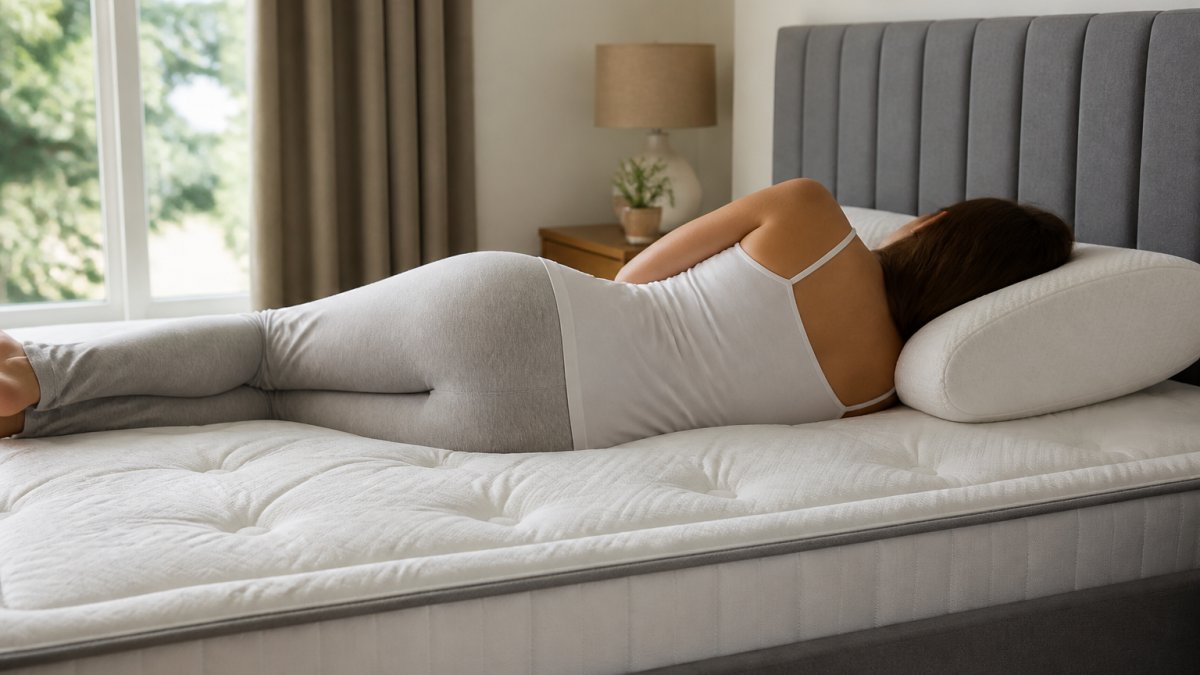
Pressure relief is the whole job. When you lie on your side, your body weight concentrates on a small contact patch at the shoulder and another at the hip. A mattress with enough give in its top layers spreads that load instead of pinning it. Look for a comfort layer that lets the shoulder settle in without a fight, and a support core that stops the hip from bottoming out. Too much sinkage and you roll forward; too little and your arm goes numb.
Spinal Alignment and Support
Spinal alignment is the test that matters more than any label on the packaging. Lie on your side and imagine a straight line from the base of your neck through your tailbone. A good mattress for side sleepers holds that line. If your waist dips toward the mattress, it is too soft. If your shoulder and hip feel jammed upward, it is too firm. Support is not about hardness; it is about holding the middle of your body level while the ends sink.
Mattress Firmness for Side Sleepers: Finding the Right Balance
Medium-soft to medium firmness is the usual starting point for side sleepers, and it is where most people should begin. That range gives the shoulder and hip room to settle while keeping the lower back supported. Firmness ratings run from 1 (softest) to 10 (firmest), and most side sleepers land between 4 and 6. But “medium” is not a fixed point, it is a relationship between your body and the build, and the same mattress can feel supportive to one side sleeper and punishing to another.
Why body shape matters more than the label
Most buying guides stop at sleep position. The more useful question is how your shoulder-to-hip proportions distribute load. A side sleeper with broad shoulders and a narrow waist presses hard into the shoulder zone but leaves a gap at the waist; a straighter frame spreads weight more evenly and can tolerate a firmer surface. Two people of the same weight can need different firmness because their weight sits in different places.
A practical way to think about it:
- Broad shoulders, narrow waist: you need a giving comfort layer at the shoulder and a core that still fills the waist gap. A medium-soft hybrid usually works better than a uniform foam block.
- Wide hips relative to shoulders: the hip is the pressure point, so look for zoned support or a slightly softer hip zone to stop the pelvis dropping and the lower back twisting.
- Straight or athletic frame: weight is distributed more evenly, so a straight medium or medium-firm often feels right, you are less likely to get the “plank” feeling at the shoulder.
- Petite frame: you press into the mattress less deeply, so a medium-firm bed can feel hard. Start softer than the label suggests and test lying down, not sitting.
Weight, sinkage and the firmness trap
Body weight changes how far you sink. Lighter sleepers often need a softer surface because they do not press through the comfort layer, so a medium-firm bed can feel like a board.
The trap is buying firmness as a proxy for quality. A firm mattress is not more supportive for a side sleeper; it is more likely to block the shoulder and push the spine out of line. Support comes from the core holding the middle of your body level while the top layers let the shoulder and hip settle.
Pro Tip
Ignore the firmness label and test with your own body. Two mattresses both rated “medium” can feel completely different because the rating is subjective and not standardised across brands. Bring your own pillow, lie on your side for a full ten minutes, and judge by whether your waist is level, not by the number on the ticket.
A quick firmness starting point
| Sleeper profile | Starting firmness | What to check |
|---|---|---|
| Petite or light, broad shoulders | 3-4 (medium-soft) | Shoulder sinks without waist sagging |
| Average build, straight frame | 4-5 (medium) | Spine stays level from neck to tailbone |
| Average build, wide hips | 4-5 with zoned support | Hip does not drop below shoulder line |
| Heavier sleeper | 5-6 (medium-firm) | Core holds; no bottoming out at hip |
Use the table as a starting point, not a verdict. The only reliable test is lying on your side long enough for the comfort layer to respond to your body heat and weight.
Memory Foam vs Pocket Sprung Mattress: Which Suits Side Sleepers?
Most comparisons of memory foam and pocket sprung mattresses stop at “foam contours, springs bounce.” That is true but not useful when you are choosing. For a side sleeper, the decision turns on three things: how the top layer behaves under a concentrated shoulder-and-hip load, how the build handles heat and movement, and how it holds up after months of nightly compression. The third is where most guides go quiet, and it is the one that decides whether the mattress still suits you in year three.
How each build behaves under a side-sleeper load
Memory foam softens with body heat and moulds to the contact patch at the shoulder and hip. That is excellent for pressure relief because the load is spread across a wider area rather than pinned to a point.
Pocket sprung mattresses use individually wrapped springs that compress only where weight is applied. The response is immediate and localised, so the shoulder and hip get give while the surrounding surface stays stable.
A hybrid pairs a foam or micro-pocket comfort layer with a pocket sprung core.
| Build | Pressure relief | Temperature | Ease of turning | Long-term behaviour |
|---|---|---|---|---|
| Memory foam | High | Warmer | Slower | Softens and can develop body impressions |
| Pocket sprung | Medium | Cooler | Easy | Springs hold shape; upholstery may settle |
| Hybrid | High | Balanced | Good | Depends on foam quality and spring gauge |
The durability question most guides skip
A mattress that feels perfect in the showroom can change character once the comfort layer has been compressed night after night in the same two spots. Memory foam is the most susceptible: lower-density foams soften faster, and the shoulder and hip zones are exactly where side sleepers load them.
Pocket sprung units generally hold their shape better because steel springs do not take a permanent set in the way foam does, but the upholstery layers above them still settle.
Key Takeaway
For a side sleeper, judge a mattress on how it will feel in year three, not just on day one. Foam density and spring gauge are the two specifications that predict whether the shoulder and hip zones keep their support.
Which should you choose?
If pressure relief at the shoulder and hip is your priority and you do not sleep hot or move much, memory foam is a strong fit, provided the foam is dense enough to resist early softening. If you get warm, change position often, or want a surface that recovers quickly, pocket sprung or hybrid is the better bet. For most side sleepers who want cushioning without the heat and a build that holds its shape, a hybrid with a responsive top layer is the safest compromise.
Best Mattress for Shoulder Pain: What to Look For
If shoulder pain is your reason for shopping, cushioning at the shoulder is the single most important feature. A mattress that lets the shoulder press down and forward takes strain off the joint. Look for a soft, giving comfort layer over a supportive core, and avoid anything rated firm, which drives the shoulder upward and compresses it.
Side sleeping on a too-firm surface is a common cause of morning shoulder ache. Back sleeping on the same bed often feels fine, which is why people miss the connection. If you wake with a sore shoulder on the side you sleep on, firmness is the first thing to question.
Watch Out
Do not buy a firm mattress to “fix” shoulder pain. Firmness increases pressure on the shoulder joint and usually makes it worse for side sleepers. Aim softer at the shoulder, firmer through the core.
Choosing a Mattress for Side and Back Sleepers
Combination sleepers who mostly lie on their side but roll onto their back need a mattress that works in both positions. Medium firmness is the practical compromise: soft enough to cushion the shoulder on your side, firm enough to support the lower back when you roll flat.
The tricky part is the transition. A mattress that is perfect on your side can feel too soft on your back, letting the hips sink. A hybrid with a responsive top layer handles the switch better than a deep memory foam bed, because it springs back as you change position.
How to Test a Mattress for Side Sleeping
Testing a mattress properly takes more than a quick sit. Use this routine before you commit:
- Lie on your side for a full ten minutes, not thirty seconds
- Bring your own pillow so your neck angle is realistic
- Check that your shoulder and hip sink in without your waist sagging
- Roll from side to back and back again to test responsiveness
- Notice heat build-up after five minutes
- Ask about the sleep trial and returns before buying
- Confirm the mattress depth suits your bed frame and sheets
If you cannot visit a showroom, use the retailer’s sleep trial as your test. A trial lets you sleep on the mattress in your own home, which is the only place the test really counts. Ask how long the trial runs and who covers return costs before you buy.
Conclusion
The right mattress for side sleepers comes down to cushioning at the shoulder and hip, support through the middle, and a firmness that matches your body weight. Get those three right and the rest is detail. At HSH-furniture-northants, we help you work through exactly that, with a family-run service built over more than 35 years and a Finedon showroom where you can lie down and test properly. Browse our range of beds and mattresses online or visit us to find the mattress that suits how you actually sleep.
Frequently Asked Questions
What mattress firmness is best for side sleepers?
Most side sleepers do best on a medium-soft to medium mattress. This allows the shoulder and hip to sink in enough to relieve pressure while still keeping the spine supported. If you are lighter, a softer feel often works well; if you are heavier, a medium firmness may be better. The key is that your shoulder and hip should not feel pinched, and your spine should stay roughly straight.
Are memory foam or pocket sprung mattresses better for side sleepers?
Both can work well. Memory foam contours closely to the body, which helps cushion pressure points at the shoulder and hip. Pocket sprung mattresses offer more bounce and airflow, and the individual springs can support the body evenly. Many side sleepers prefer a hybrid that combines pocket springs with a foam comfort layer. Try both if you can, and prioritise how your shoulder and hip feel after ten minutes lying on your side.
How do I know if my mattress is causing my shoulder pain?
If you wake with shoulder stiffness or numbness that eases during the day, your mattress may be too firm or lacking cushioning at the pressure points. A mattress that is too soft can also cause pain by letting the spine sag. Check whether the pain is worse on the side you sleep on. If so, look for a mattress with a softer comfort layer and better pressure relief.
What should I look for when buying a mattress for side sleeping?
Focus on pressure relief, spinal alignment and firmness. Look for a mattress with a soft-to-medium comfort layer over a supportive base, such as memory foam over pocket springs. Check the sleep trial and return policy, especially if you cannot lie on it first. Also consider temperature regulation and edge support. A mattress that keeps your shoulder and hip cushioned without letting your spine sag is the right choice.